


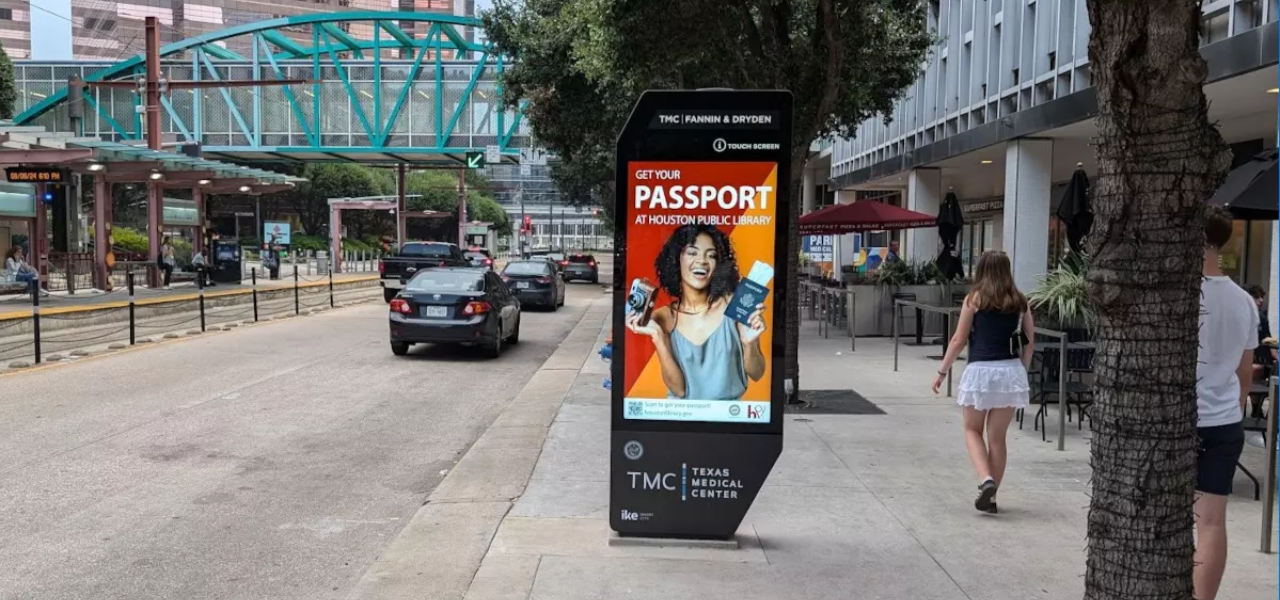


Prescription dispenser
Table of Contents
Sign up to our newsletter
With the help of these kiosks, people’s interactions with the public information and navigation around the cities have been revolutionized.
This article elaborates on smart city advertising kiosks alongside their key features, advantages, and methods of implementation.
What is a Smart City Advertising Kiosk?
It is an advertising kiosk that comes with lots of upsides, such as integrating a social kiosk, a site ad, and other forms of informational ad.
Due to its convenience, it is no wonder that these kiosks are predominantly located in urban areas as they display advertising and offer various services and features that are useful to their users.
Equipped with touch screens and an internet connection, smart city kiosks are designed to offer every user value for their money.
They can also advertise public service campaigns to local businesses and sell you space at reasonably low rates.
They form the backbone of the digital ecosystem of a city and are purpose-built for efficiency and ease of use. Multilingualism and ADA compliance are some of the additional factors that are taken into consideration.
Key Features of Smart City Kiosks
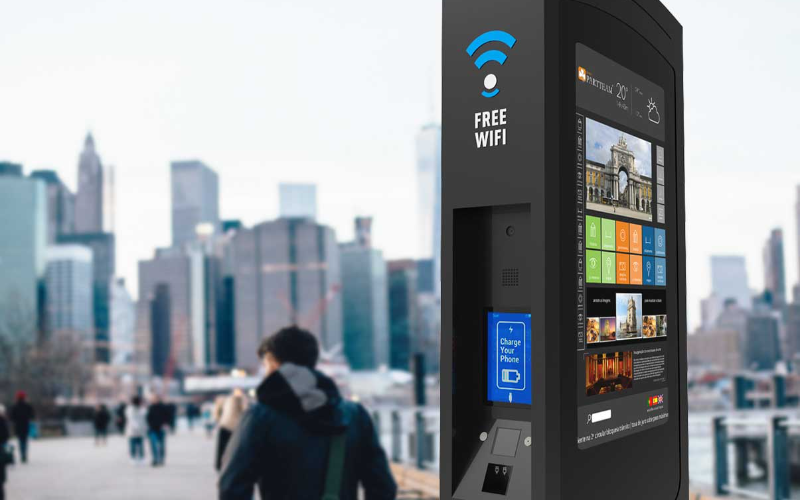
Suited to the various needs of city dwellers, the smart city kiosks are intuitive, interactive, and convenient. The most crucial things to them are the following:
Real-time Information Display
Real-time information displaying smart kiosks are provided with information about the town, its activities, important news and announcements, climatic changes, and the expected time of the next public transport.
Generally, with such an unusual but useful feature, when a user logs into the system, they can expect to receive relevant information as everything is time-sensitive and content is always up to date.
Touch and Multi Touch Screens
One of the standout features of smart city kiosks is the multi-touch interface that allows people to interact with them. Thanks to active user engagement, citizens obtain maps, city services, or necessary information effortlessly.
Support for Multiple Languages
The global nature of cities today explains the need for digital kiosks to be offered in various languages.
This characteristic serves as a boon to city residents, tourists, international visitors, and business people, as it enables people who speak different languages to access much-needed information and resources.
Compliance with the Americans with Disabilities Act (ADA)
A number of smart city kiosks exist that are able to assimilate people with a number of impairments, and most of them are compliant with the Americans with Disabilities Act.
This means that voice assistance, braille, and the ability to raise a screen to an appropriate height are elements added to the kiosks, allowing for the fitting of these kiosks to impaired people.
These functionalities have been integrated into smart city kiosks, enabling users to interact with them easily. Therefore, these kiosks will be able to serve the different requirements of businesses, tourists, and citizens.
Advantages of Smart City Kiosks

The existence of smart city kiosks is useful as it enhances accessibility, interaction, and effectiveness in the urban space. Below are several benefits of smart city kiosks.
Enhanced Interaction Among Residents and Tourists
Smart kiosks increase user interaction by engaging users with entertainment, information, and services that relate to entertainers or host tourists and locals.
Smart kiosks also engage users with businesses and governmental institutions by exposing them to rich materials.
Enhanced Wayfinding
It helps consumers with orientation by providing effective maps with GPS and other location-based services. If needed, they can also inform users about alternate ways to reach a certain destination.
They can also provide the expected time of arrival of buses and trains using sensors that track the movement of vehicles on the roads in real-time.
This is greatly helpful to both tourists and natives as it makes exploring the cities much easier.
Advertising and Marketing Possibilities for Local Enterprises
Smart city kiosks help local businesses get to their target clients. It helps people to position their products and services in front of consumers, in their line of vision.
Also, the kiosks will consider advertisements for nearby firms and show them that businesses will be able to catch the eyesight of prospective clients.
Easier Availability of City Services and City Information
With the help of these kiosks, users can quickly access relevant services such as details about transportation, emergency threats, or assistance from the government.
By making information available in one location, the kiosks promote rapid and efficient communication between citizens and local authorities.
Types of Smart City Kiosks
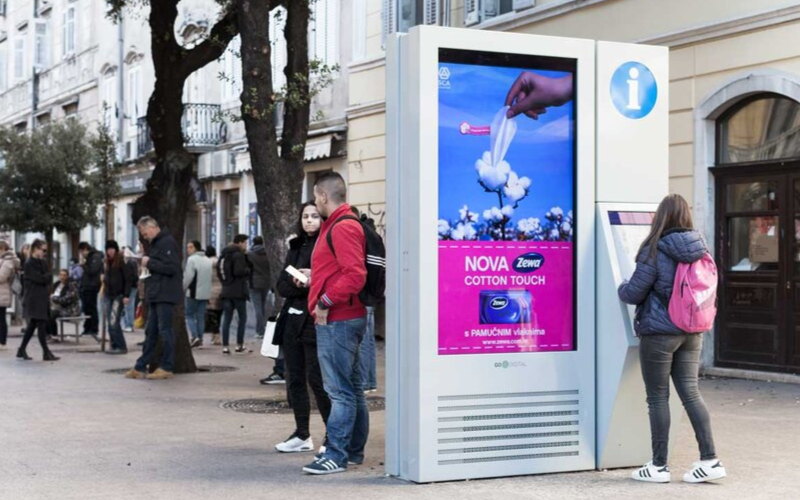
Urban conditions and requirements have influenced the construction of a number of smart city kiosks. They can be classified into the following major types:
Indoor Digital Kiosks
These kiosks are mainly found in busy precincts where a captive audience is seen, and these venues include public spaces, transport terminals, and centers.
More often, these kiosks in the buildings offer services, which include direction-seeking services, advertising for businesses, advertisement of events, and sales service.
Because these kiosks are shielded from the outside world, the design of the interface, material promotion, and audience engagement in confined spaces are emphasized.
Outdoor Digital Kiosks
In an urban open landscape such as cities, town centers, parks, streets, and public transport stations, outdoor smart city kiosks are placed.
These kiosks are integrated into the surrounding environment and, therefore, are subject to vandalism and weather-related damage.
Custom Kiosks
There are custom kiosk options. Cities can charge a premium on these structures provided the client zone is willing to pay for the desired amount of development.
Some features may include the addition of solar panels for energy efficiency and the installation of sensors to enable intelligent city data gathering.
Custom solutions could take care of multiple urban challenges. Every sort of smart kiosk has a different function.
However, they also have common goals – all aspire to better communication, increase accessibility, and promote civic engagement.
As for the cities, they will be able to enhance their impact on people and tourists in general by opting for the best-suited kiosk concept for the transformation of specific areas.
Implementation of Smart City Kiosks

Many factors enhancing the successful integration of the kiosks have to be considered, including design and embedding in the urban fabric.
Some of the elements that determine a successful scale-up include:
The Choice of Appropriate Locations
Kiosks should specialize in areas with high traffic coverage, for instance, in urban centres, transport interchanges, recreational sites like parks, shopping malls, and sites of interest.
In cases when there is a high need for information and service resources, kiosks are within the reach of residents and tourists. For example, the site selection requires that the locations be straightforward and available to more people.
Linking with Other Technological Possibilities
To be useful, smart kiosk systems in a city need to incorporate the existing digital solutions available in that city.
For instance, users can connect to free wi-fi in the streets, receive messages regarding the ongoing weather conditions or traffic conditions, and get connected to the public transport systems.
Other kiosks can interface with municipal systems and provide functionalities like sending notifications and advertising events.
If this connection works well, it allows the kiosks to inform the public about the availability of particular services in real time.
The Relevance of User Information and Security
The issue of security and privacy is critical in the case of smart kiosks and their users, particularly because they can act as information-collecting devices that may even interconnect with the city network.
Only the relevant information should be retrieved and protected, the channels of communication should be properly protected, and preventive measures against vandalism should be taken.
The protection of users’ data also remains important, especially in cases where services are provided in time and location, which determines the need to gather data.
It should be the responsibility of the local authorities to adopt such principles as to reasonably explain to the users what data is collected and for what purpose.
Conclusion
Smart city advertising kiosks are already enabling timely information dissemination, improving interactions in cities, and aiding small businesses in the present world.
These electronic devices enhance the daily lives of the residents and visitors of the cities. They are also important advertising media, public service, and guidance devices.
With the use of several types of kiosks, both in the open and in the shops, cities can customize their strategies according to their needs and geographical areas.
Get in touch with an expert immediately. Transform urban spaces and boost engagement with our cutting-edge smart city advertising kiosks—connect, inform, and drive revenue today!

Kitty Tan
Custom Kiosk Expert Consultant
Kitty is a kiosk expert at FlyXing. With extensive knowledge and experience in designing and manufacturing self-service kiosks, Kitty specializes in creating customized solutions to meet diverse industry needs.


