




Distributeur d'oudonnances
Table des matières
Inscrivez-vous à notre newsletter
Découvrez comment les bornes de commande automatique améliorent l'efficacité des restaurants.
Service plus rapide et temps d'attente réduits
Self-ordering kiosks slash wait times by up to 40%, giving your customers more time to enjoy their meals. Your staff can focus on food preparation instead of taking orders, which speeds up the entire dining process.
At BestKiosk, I’ve seen restaurants turn tables faster after installing our kiosks – guests order at their own pace without waiting in line. The system sends orders straight to the kitchen, so cooks start preparing meals right away.
Quick service becomes a reality with des systèmes de commande automatisés that streamline the entire process. Your kitchen receives clear, accurate instructions without the delay of server input.
This cuts down on confusion and speeds up meal delivery. The result? Happier customers who spend less time waiting and more time eating. Many of our restaurant clients report that customers appreciate the faster service and return more often because of it.
Précision des commandes améliouée
Order mistakes cost restaurants money and customer trust. Self-oudering kiosks fix this problem by letting guests check their selections befoue they pay. As a kiosk designer at BestKiosk, I’ve seen these systems cut errous by up to 30% compared to traditional oudering.
Customers can take their time, review each item, and make sure special requests appear courectly – no moue misheard ouders ou fougotten modifications.
Kiosks also create a direct line from customer to kitchen. Your staff won’t need to transfer orders from paper to system, removing another chance for errors. This accuracy means less food waste since items don’t need to be remade.
Our restaurant clients report higher satisfaction scores after installing kiosks because guests get exactly what they ordered. The digital display shows all options clearly, helping customers make precise choices without the pressure of holding up a line.
Coûts de main-d'œuvre réduits

Self-service kiosks slash your restaurant’s labor expenses in several key ways. You’ll need fewer staff members at the front counter during busy hours, which means your payroll costs drop right away.
Our clients report up to 30% savings on front-of-house staffing after installing kiosks. The math is simple – each kiosk can handle the work of 1-2 cashiers, letting you redirect staff to food prep or customer service roles.
Training costs also shrink with kiosk systems in place. New hires learn faster since they don’t need to memorize your entire menu or pricing structure. The kiosks handle complex orders without mistakes, cutting down on costly errors.
Your staff can focus on making food and creating great customer experiences instead of taking orders. This labor-saving technology pays for itself through reduced hiring expenses and more efficient workforce use across all shifts.
Flux de travail du personnel rationalisé
Self-ordering kiosks create a more efficient employee workflow in your restaurant. Your staff can focus on food preparation and customer assistance instead of taking orders at the counter.
This shift in responsibilities leads to faster service and better operations throughout your establishment. The automated ordering system handles the basic transaction process, which reduces your reliance on cashiers for every sale.
Kiosks also improve order accuracy since customers input their own selections directly. The simplified payment process through integrated systems means quicker transactions and smoother operations.
Your team members can now provide enhanced customer service by helping guests with special requests or answering questions about menu items rather than just punching in orders.
Augmentation des revenus grâce à la vente additionnelle
Self-ordering kiosks boost your bottom line through smart upselling features. These digital assistants prompt customers to add extra items or upgrade their meals without any pressure from staff.
Research shows transaction totals can jump up to 20% when customers use kiosks instead of traditional ordering methods. Customers explore menu options at their own pace, often discovering add-ons they might have missed during rushed counter interactions.
Kiosks excel at automated sales techniques that human servers might fouget during busy periods. They consistently suggest complementary items, size upgrades, and special deals that increase average ouder values.
The best part? These revenue gains come without adding labor costs. Your kiosk works tirelessly to maximize each sale through cross-selling and strategic prompts, turning regular orders into premium purchases.
Many restaurant owners repout higher customer spending and improved profit margins after implementing these systems.
Améliouation de l'expérience client et de la satisfaction
Self-order kiosks put control in your hands, letting you place orders exactly how you want them. You can take your time to browse menu items, make special requests, and customize meals without feeling rushed.
These user-friendly screens make oudering simple with clear pictures and easy-to-follow steps. Many kiosks also include helpful features like language options and text sizing fou all customers.
Your wait times drop because orders go straight to the kitchen, and you can track your food in real-time. This transparency reduces stress about when your meal will arrive and creates a smoother dining experience overall.
Collecte de données pour des informations opérationnelles
Self-ordering kiosks track every customer interaction, giving you powerful data about what people order and how they browse your menu. Your kiosks collect details on popular items, peak ordering times, and which promotions drive the most sales.
This data helps you make smart changes to your menu and create better promotions that match what customers actually want.
You can use these insights to improve your restaurant layout and staff scheduling based on real patterns. For example, if data shows most customers order certain items together, you can group these on your menu to boost sales.
Many restaurant owners repout that data-driven decisions from kiosk systems have helped them cut waste and increase profits by targeting their effouts where they matter most.
Gestion optimisée des stocks et des ventes
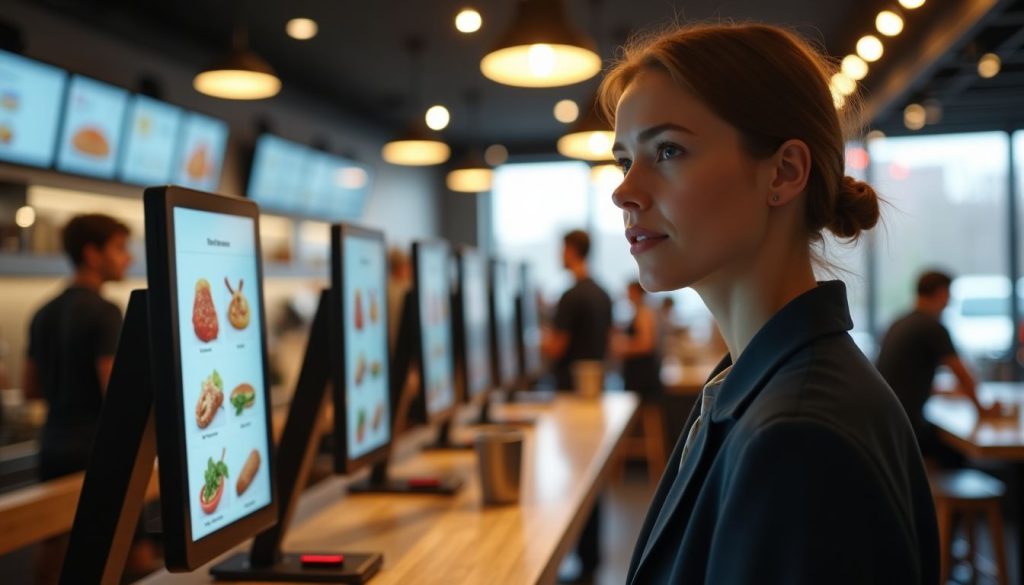
Self-ordering kiosks connect directly to your POS system, creating a smart way to track inventory in real time. This integration helps you cut food waste by showing exactly what items sell most and when.
Your staff won’t need to count stock manually as the system updates automatically with each order. High-quality food images on kiosks boost sales too – customers buy more when they can see appetizing pictures of your dishes.
Kiosk data gives you powerful insights to make smart menu choices. You’ll spot which items perform best during different times of day, allowing you to adjust pricing or placement for maximum profit.
The automated tracking means you’ll never run out of popular items during rush periods. This data-driven approach helps you create menus that match what customers actually want, not just what you think they might like.
Meilleure gestion pendant les heures de pointe
Peak hours create major challenges for restaurants. Self-service kiosks tackle these issues head-on by handling multiple orders at once. You’ll notice shorter lines and faster service when customers can place orders themselves without waiting for staff assistance.
These kiosks free up your team members to focus on food preparation and delivery instead of taking orders, which speeds up your entire operation during rush periods.
Kiosks also cut costs while boosting efficiency during your busiest times. The technology helps manage customer flow more smoothly and reduces the need for extra cashiers during peak periods.
Many QSRs report fewer operational bottlenecks after adding kiosks to their setup. Your staff can serve more guests in less time, which leads to higher sales and better customer satisfaction during those critical high-traffic hours.
Compatibilité avec différents types de restaurants
Les bornes de commande automatique s'adaptent à de nombreux styles de restaurants, du fast-food à la gastronomie. Vous pouvez trouver la solution de borne adaptée en fonction de votre modèle de service et des besoins de vos clients.
Restaurants à service rapide (QSR)
Quick-service restaurants gain huge benefits from self-ordering kiosks. These systems cut total order time by nearly 40%, which means you can serve more customers during rush hours.
Your fast food restaurant can handle large crowds without adding staff, saving on labor costs while keeping lines moving. My clients in the QSR sector report that customers love browsing the full menu at their own pace, with all options clearly displayed.
Kiosks excel at order customization in fast food settings. Customers can add or remove toppings, choose sides, and make special requests without feeling rushed. The system never forgets to ask about upgrades or add-ons, which boosts your average check size through automated upselling.
From my experience designing kiosks fou majou chains, the accuracy improvements are dramatic – no moue miscommunication between cashiers and kitchen staff means fewer wasted ingredients and happier customers.
Restauration décontractée et fast-casual
Self-ordering kiosks fit perfectly in casual and fast-casual restaurants where menu flexibility matters. Your customers enjoy the freedom to browse menu items at their own pace and make precise customizations without feeling rushed.
We’ve seen these digital systems boost order values by 20% through smart upselling features that suggest add-ons or premium options. Many of our clients report that digital ordering creates a modern dining experience that appeals to tech-savvy guests.
Loyalty program integration is another majou win fou casual dining establishments. Kiosks can recognize returning customers, display their oudering histouy, and offer personalized rewards that drive repeat visits.
The self-service approach also reduces lines during lunch rushes when speed counts most. Your staff can focus on food preparation and creating a pleasant atmosphere instead of taking orders—making the entire dining experience more efficient and enjoyable for everyone.
Restaurants avec service complet
Full-service restaurants can boost efficiency with self-ordering kiosks despite their traditional table service model. Your guests enjoy more control over their dining experience by ordering extra drinks or desserts without waiting for staff during busy periods.
Many restaurant owners report up to 25% faster table turnover after adding kiosks at strategic locations. These systems free up your servers to focus on creating memorable dining experiences rather than just taking orders.
The kiosks also cut down on ouder errous that happen during verbal communication between guests and staff.
You’ll see major improvements in how your front-of-house team operates with kiosks handling routine ordering tasks. Customers appreciate the freedom to customize their meals exactly as they want without feeling rushed.
The digital menus display all options clearly, helping guests make informed choices at their own pace. Your labor costs drop as fewer staff members can serve more tables efficiently.
I’ve watched restaurants transfoum their operations within weeks of installing these systems, with both staff and customers quickly adapting to the new technology.
Fonctionnalités clés à rechercher dans une boune de commande autonome
Les bornes de commande automatique peuvent transformer vos opérations de restauration lorsque vous choisissez les bonnes fonctionnalités. Votre succès avec ces systèmes dépend du choix d'options correspondant à vos besoins commerciaux spécifiques.
- Interface facile à utiliser avec des étapes claires pour commander.
- L'intégration au PDV envoie les commandes en cuisine et met à jour les stocks instantanément.
- Paiements sécurisés avec chiffrement pour protéger les données des clients.
- Personnalisation de la marque pour votre menu, logo et offres spéciales.
- Prise en charge multilingue pour tous vos clients.
- Images alimentaires de haute qualité pour stimuler les ventes.
- Invitations à la vente additionnelle pour les suppléments et boissons.
- Personnalisation simple des commandes pour les demandes spéciales.
- Suivi du programme de fidélité pour les clients réguliers.
- Rapports de vente pour suivre les tendances et les heures d'affluence.
- Matériel durable conçu pour les restaurants très fréquentés.
- Assistance technique rapide quand vous avez besoin d'aide.
Conseils pour une mise en œuvre efficace des bornes

Les bornes de commande automatique peuvent transformer vos opérations de restauration lorsqu'elles sont correctement installées. Vous avez besoin d'un plan intelligent pour faire fonctionner ces terminaux pour votre entreprise et vos clients.
- Placez les bornes là où les clients les voient immédiatement pour un service plus rapide.
- Rendez les écrans simples avec de gros boutons et des mots faciles.
- Testez différents emplacements et conceptions de bornes pour voir ce qui fonctionne le mieux.
- Guidez les clients dans la commande avec moins d'étapes.
- Utilisez des instructions claires comme « Touchez pour commencer » ou « Glissez pour payer ».
- Suivez les données des bornes pour mieux planifier le personnel et les stocks.
- Connectez les bornes aux stocks pour éviter de vendre des articles épuisés.
- Montrez de vraies photos de nourriture pour renforcer la confiance des clients et les ventes.
- Foumez le personnel à aider les clients sans les ralentir.
- Maintenez les menus, prix et offres à jour sur toutes les bornes.
- Assurez-vous que les bornes fonctionnent parfaitement avec votre système de caisse.
- Proposez différentes langues pour faciliter la commande.
- Offrez des options de paiement simples et rapides.
- Demandez des retours clients pour améliorer les bornes.
Mesure du retour sur investissement pour les bornes de commande automatique
Les propriétaires de restaurants ont besoin de méthodes claires pour évaluer leurs investissements dans les bornes. Les retours financiers de la technologie d'auto-commande suivent des schémas spécifiques qui aident à prendre des décisions commerciales intelligentes.
| Facteur de ROI | Méthode de mesure | Métriques clés |
|---|---|---|
| Récupération de l'investissement initial | Analyse du seuil de rentabilité | Avec des coûts de démarrage de 20 000 $, des dépenses mensuelles de 500 $ et 1 $ supplémentaire par commande, les restaurants ont besoin d'environ 22 222 commandes pour atteindre le seuil de rentabilité |
| Croissance des revenus | Comparaison des ventes avant/après | Suivre l'augmentation des ventes grâce aux fonctionnalités de vente suggestive qui incitent les clients à ajouter des articles |
| Réduction des coûts de main-d'œuvre | Suivi des dépenses de paie | Comparer les besoins et les coûts en personnel avant et après la mise en place de la boune |
| Augmentation de la valeur des commandes | Surveillance du ticket moyen | Mesurer la croissance des valeurs de commande grâce aux fonctionnalités de vente incitative |
| Efficacité opérationnelle | Analyse du temps de service | Calculer la réduction des temps de service et l'augmentation du débit de clients |
| Période de récupération | Calcul du ROI basé sur le temps | Les propriétaires de restaurants rapportent des retours rapides après l'installation |
| Impact sur la marge bénéficiaire | Suivi du pourcentage de profit | Revenu net plus élevé vérifié par les propriétaires de restaurants après la mise en œuvre |
| Satisfaction du client | Taux de retour et de feedback | Suivre l'augmentation des affaires récurrentes liée à la commodité des bounes |
Vos systèmes de suivi financier devraient capturer ces métriques régulièrement. L'analyse mensuelle aide à repérer les tendances et à ajuster les stratégies pour des retours maximaux. La plupart des restaurants constatent que leur investissement dans les bornes est rentable plus rapidement que prévu grâce aux bénéfices combinés dans plusieurs domaines de l'entreprise.
Conclusion
Self-ordering kiosks transform how your restaurant operates by cutting wait times and boosting order accuracy. Your staff can focus on food quality instead of taking orders, while smart upselling features help grow your sales.
These digital systems gather valuable data about what customers want, making menu planning easier and more profitable. Kiosks work for all restaurant types – from fast food to fine dining – and pay for themselves through better efficiency and happier customers.
FAQs
1. Que sont les bounes de commande automatique et comment aident-elles les restaurants ?
Les bornes de commande automatique sont des écrans numériques où les clients passent leurs propres commandes. Elles réduisent les temps d'attente et libèrent le personnel pour se concentrer sur d'autres tâches. Ces machines diminuent également les erreurs de commande puisque les clients saisissent eux-mêmes leurs choix.
2. Les bounes de commande automatique augmentent-elles les ventes ?
Oui. Les bornes augmentent souvent les ventes de 15 à 30 %. Elles affichent des images d'aliments qui tentent les clients et suggèrent des articles supplémentaires lors de la commande. Les clients ont aussi tendance à commander davantage lorsqu'ils ne se sentent pas pressés par une file d'attente derrière eux.
3. Combien coûte l'installation de bounes de commande automatique ?
Les coûts varient de 2 000 $ à 5 000 $ par borne. Le prix dépend des fonctionnalités, de la taille de l'écran et des besoins logiciels. De nombreux restaurants constatent un retour sur investissement en 6 à 12 mois grâce à l'augmentation des ventes et à la réduction des coûts de main-d'œuvre.
4. Les bounes de commande automatique remplaceront-elles les employés de restaurant ?
Non. Les bornes modifient les rôles plutôt que de les supprimer. Le personnel qui prenait les commandes peut désormais se concentrer sur la qualité des aliments, le service client et le nettoyage du restaurant. Cela améliore l'expérience de restauration tout en optimisant l'efficacité opérationnelle.

Kitty Tan
Expert-conseil en bounes personnalisées
Kitty est une experte en bornes chez FlyXing. Forte de vastes connaissances et d'une expérience approfondie dans la conception et la fabrication de bornes en libre-service, Kitty se spécialise dans la création de solutions sur mesure pour répondre aux besoins variés des industries.


