


Prescription dispenser
Table of Contents
Sign up to our newsletter
This guide provides you with a detailed understanding of self-check-in kiosks and receptionist desks. You can learn the benefits and challenges of each approach. Both offer unique experiences to your guests. You can decide which is best for providing your guests with the most hospitable experience.
What are Self-Check-In Kiosks?
Self-check-in kiosks allow you to check in without needing any help from the staff. You can directly interact with the touchscreen for tasks such as booking hotel rooms, hospital appointments, or flight tickets.
You also don’t have to go after staff members and ask for their time. Self-check-in kiosks not only save your time but also provide you with the simplest options.
Provide your identification details, such as by scanning your password or ID card. You can confirm your verification by touching “ok” on the touchscreen.
How They Work
Self-check kiosks provide you with touchscreen features. You don’t have to interact face-to-face with staff members. This really saves your time in busy places.
Its working is simple. You need to enter your information, booking number, and ID details, or scan a QR code.
It verifies your information to confirm the booking or reservation. You can also set your preferences, like seat numbers or room upgrades. After verification, the kiosk prints your tickets, and you are done with the self-check-in process.
Key Technology Features
Self-check-in kiosks provide you with the latest innovative features. Some key features that you may have include touchscreen displays, customisation, automatic payment, identity verification, and receipt or ticket printers. You also have a demo option that includes step-by-step guidance.
What is a Receptionist Desk?
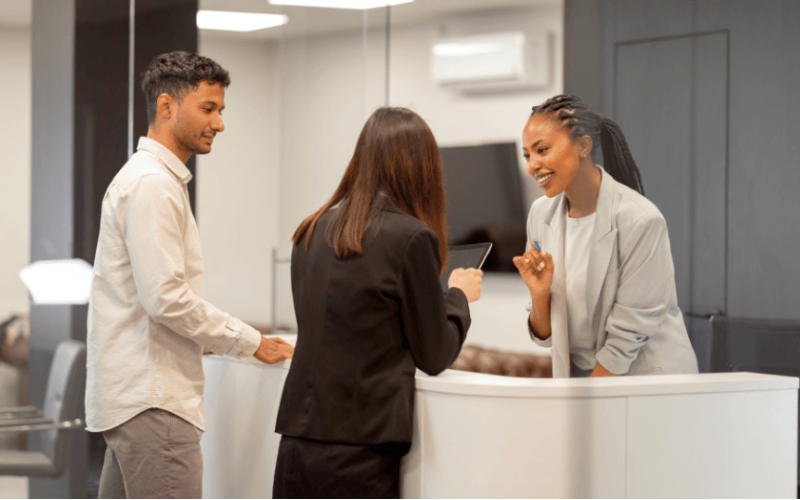
A receptionist desk is often known as a front desk. It is a greeting and welcoming area in places like offices, hotels, or clinics. It has to welcome guests and address customer queries.
It provides you with every single detail. This place gives a professional first impression. As this is the first place a client goes after stepping into a place.
Role and Main Function
The receptionist’s desk provides guests with a welcoming and professional environment. It is assigned to set the overall vibe of the place. It answers questions, provides any required guidance, and ensures the guest knows where to go and what to choose.
Importance of Human Interaction
Human interaction is impossible to replace. The kindness, warmth, and sense of togetherness a receptionist gives can’t be achieved with a machine. A machine can make a process easy and fast, but it can’t turn it into a lived experience or a journey.
A person might have some personal concerns to discuss and need guidance. However, a machine can’t go beyond its programming. Above all, a smile or a kind gesture can make someone’s day or result in a long-lasting bond that a machine can’t provide.
Benefits of Self-Check-In Kiosks
Self-check-in kiosks have been the talk of the town. They have replaced the work of 5-10 members with just one machine. A client can select options from the screen, and here you go. No need to bear the staff’s tantrums or wait till your number comes.
Let’s see some key benefits you have with self-check-in kiosks.
Faster Check-Ins

Self-check-in kiosks provide their users with faster-than-ever check-ins and check-outs. A user can complete the verification or booking process in just a few minutes. Guests don’t have to deal with human errors such as mistyped information or misunderstanding. This means shorter queues and happier customers.
Better Privacy for Guests
Self-check-in kiosks use multiple features to save user data. This may include encryption and tokenization, continuous monitoring and surveillance, and other software-level security features. This multi-layered security keeps the user’s data safe and secure.
Customers often feel more comfortable sharing their data over a device. It reduces the risks of sensitive data being overheard in public. Self-check-in kiosks reduce human errors when entering guests’ data, such as incorrect phone numbers, names, or addresses.
Available Anytime, Day or Night
Kiosks are available to customers 24/7 and are always in service. Now, you don’t need to worry about late check-ins or early morning checkouts. It also eliminated the dependency on staff hours.
These kiosks are considered cost-effective for businesses. Now, businesses don’t have to pay for night shifts or extended hours. This is very helpful when you have late-night flights or face unexpected delays.
Benefits of a Receptionist Desk

A receptionist helps businesses to build trust by making clients feel heard and welcomed. A machine can only guide users based on given instructions. Only human interactions can go beyond providing a customized environment for each guest.
Personalized Help for Guests
A receptionist’s desk makes sure that every guest feels welcomed and valued. A machine can’t go beyond software SOPs. A receptionist can go deeper to understand a guest’s specific needs.
Managing Complex Requests
It is not possible to have a clear solution for everyone. Some problems may require personalized guidance. Receptionists may help guests with accommodating last-minute bookings. They can understand complaints and coordination issues among various departments. Machines are unable to understand the urgencies.
Empathy, kindness, or going beyond SOPs to assist a guest is what makes receptionists stand out. If a guest misses their flight, a receptionist can’t only assist in re-booking but also help in calming their frustration.
Opportunities for Upselling Services
Face-to-face communication helps in understanding the person’s preferences better. Receptionists work best in convincing guests of add-ons, upgrades, or promotions. This is because receptionists not only interact with the guests, but they also make sense of their needs.
When a lady enters the reception, all dressed up, the receptionist might offer a room that comes with a 10% off at spa and salon services.
Challenges of Both Options
While both self-check-in kiosks and receptionist desks have their advantages, they both come with some challenges as well. Below are the key challenges you might encounter.
Limited Personal Interaction with Kiosks
Self-check-in kiosks, though efficient, still lack the human touch. Guests who need assistance with queries that are not common in the kiosk data can only be addressed at the receptionist kiosk. Kiosks are unable to address issues that involve emotions, like frustration after flight delays or urgent flight bookings.
Guests who are not aware of kiosk technology may find it hard to navigate such devices. Hence, the receptionist can guide such guests in the simplest manner so they can use these machines with little familiarity with these devices.
Efficiency Issues at Reception Desks
Efficiency issues are always present in the case of human staff. Misunderstanding, incorrect guest details, or slower functioning speed make the process inefficient (sometimes). Kiosks that can handle multiple tasks simultaneously; one receptionist can handle only one guest at a time.
Also, installing a kiosk device is a one-time, long-term investment, whereas a receptionist desk requires paying the staff every month. Also, communicating misunderstandings, tassels, or sometimes politics can give the desk a headache.
The Future of Hotel Check-Ins
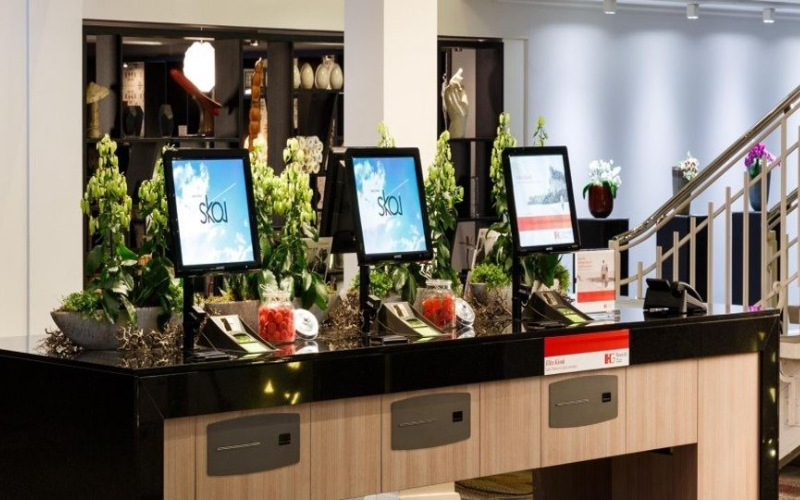
The future of hotel check-ins is all about maintaining the balance between automation and human service. Self-service kiosks are supposed to provide faster and more efficient services, where the receptionist desk is there to make your guests feel heard, welcomed, and valued.
Combining Technology with Personal Service
Instead of choosing one, hotels can provide their guests with a welcoming as well as a technologically advanced environment. Self-service kiosks must be placed for efficient and faster check-ins. However, receptionists must also be there to address any additional needs of guests.
Although kiosks offer you one-time investments, human service fills this gap by upselling services. They can convince guests to sign up for additional services by offering discounts or promo codes. This hybridity will give hotels the ability to have a technologically advanced ambience alongside their team of professionals.
Changes in What Guests Want and Expect
Whether you want to opt for a self-service kiosk or go for human service, the decision must be made by keeping in mind your target customers. With technological advancements, every individual now needs comfort and efficiency. Nobody wants to keep waiting in lines or how their name is spelled. This generation and the generations to come are not going to compromise on their comfort. So, technological efficiency needs to be there for hotels to attract their target customers.
However, future generations are also not going to compromise on personalized attention. With technology comes competitions (no slots available, already booked) and frustrations (delays, missed flights). Such high-stress situations can only be understood and addressed by other humans.
Conclusion
Self-check-ins provide easier, faster, and 24-hour services to their users. The receptionist desk adds an emotional touch to its services, such as making guests feel comfortable and assisting them with their specific concerns.
However, both have their own challenges, such as loss of personal interaction in the case of kiosks and loss of efficiency in the case of human services. Rather, it is about creating a seamless balance between the two that can address evolving guests’ demands and needs.
Ready to upgrade your kiosk self-check-in process? Explore the best solutions at Bestkiosk. Give your guests the blend of innovation and interaction. Visit us today and transform your hospitality services!

Kitty Tan
Custom Kiosk Expert Consultant
Kitty is a kiosk expert at FlyXing. With extensive knowledge and experience in designing and manufacturing self-service kiosks, Kitty specializes in creating customized solutions to meet diverse industry needs.


